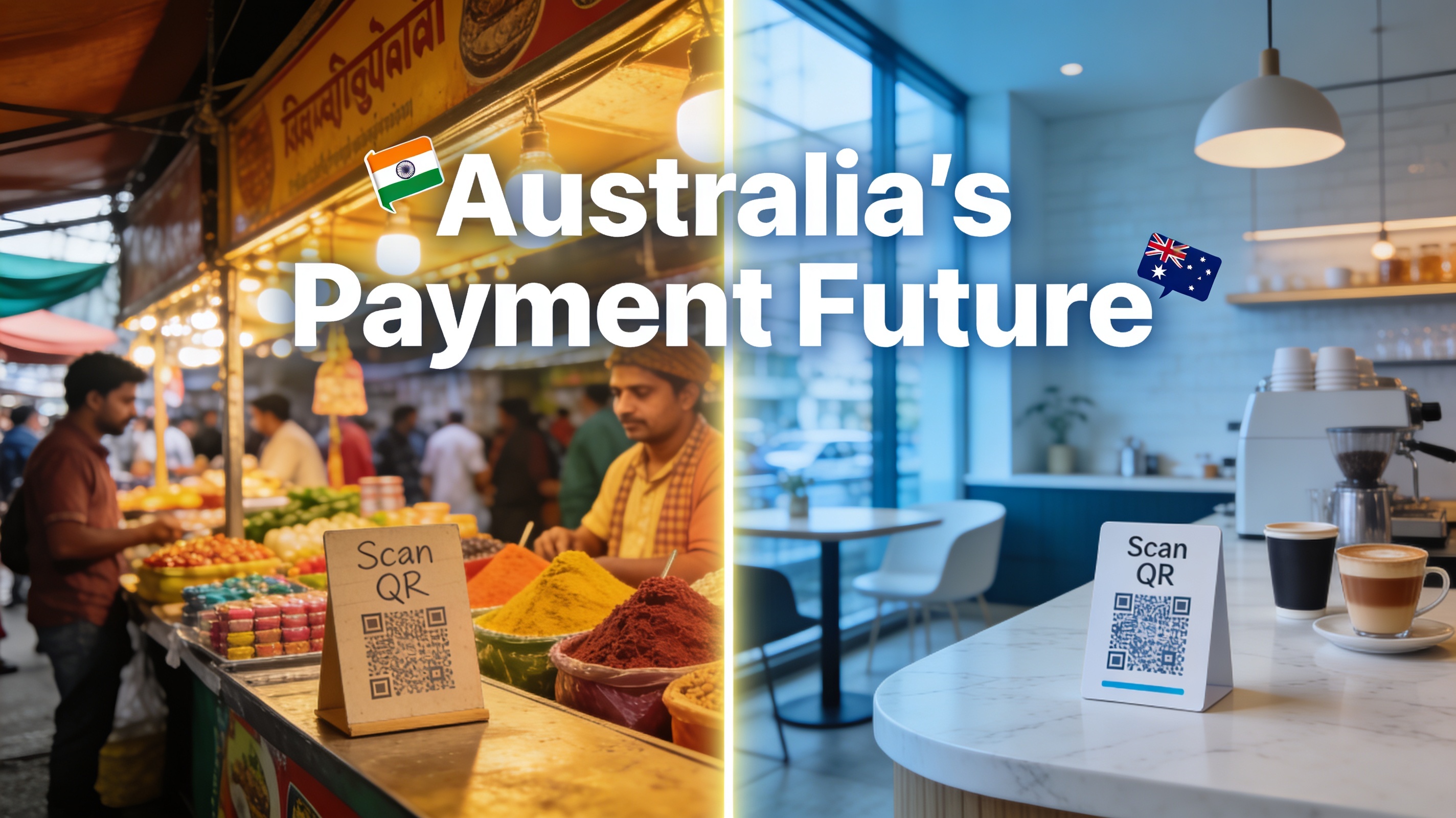
India has UPI. Brazil has Pix. China has Alipay. Australia has the infrastructure — but not the ambition. Here's why Australia needs a universal QR payment standard, and what Aussie businesses can do right now.
If you've ever visited India or dealt with Indian customers, you've probably seen it: someone walks up to a street food stall, scans a tiny QR code on a piece of paper, types an amount, and the payment is done in two seconds. No card. No surcharge. No "tap and wait." Just done.
That system is called UPI — Unified Payments Interface. It processes over 640 million transactions every single day — for free. Meanwhile in Australia, we're still fumbling for the right card, tapping twice because the terminal froze, or getting slugged with a 1.5% surcharge just for paying electronically.
So why doesn't Australia have something like UPI? And more importantly — could QR codes be the bridge that finally gets us there?
What Is UPI and Why Is It So Impressive?
UPI was built by India's National Payments Corporation of India (NPCI) — a government-backed body — and launched in 2016. It created a single, open, interoperable layer on top of every bank in India. Any app (Google Pay, PhonePe, Paytm) can plug in and send money between any two bank accounts instantly, at zero cost to both the user and the merchant.
The genius of UPI is the QR code. Every merchant — from a Bollywood cinema to a roadside chai vendor — has a printed QR code on the counter. Customers scan, confirm, done. No terminal to buy. No monthly fees. No special hardware. Just a piece of paper and a smartphone.
Does Australia Have an Equivalent?
Yes — sort of. Australia launched the New Payments Platform (NPP) in 2018, with PayID as its addressing layer. PayID lets you send money using just a mobile number or email instead of a BSB and account number. There are now over 25 million registered PayIDs in Australia, and one in three payments is processed via the NPP.
More recently, PayTo was introduced — allowing businesses to pull real-time payments from customers' bank accounts with prior authorisation. And Australian fintechs like Azupay are already building QR-code-based payment flows on top of this NPP infrastructure.
So the plumbing exists. The experience, however, doesn't.
Why Australia Is Still Behind
Three structural reasons explain the gap:
1. Banks run the show, not the government.UPI succeeded because India's government mandated zero-fee interoperability and forced every major bank to participate. In Australia, the payments ecosystem is industry-led — meaning the big four banks (CBA, Westpac, ANZ, NAB) have enormous influence over how things are built and priced. They have little commercial incentive to eliminate the surcharge model that earns them billions.
2. We never had a forcing event.India's UPI was turbocharged by the 2016 demonetisation shock — overnight, half a billion people had to go digital because cash became unusable. Australia's contactless card payments were already smooth and widespread, so there was no crisis that forced a leap to something better.
3. Regulation is still catching up.The Australian Banking Association only pushed Parliament in early 2025 to modernise the payments regulatory framework. The RBA is still working out how to regulate Apple Pay and Google Pay on equal footing with banks. Real structural change is years away.
The World Has Already Solved This — Here's How
Australia isn't the only country that wrestled with this question. Here's how the rest of the world answered it — and what we can learn.
🇨🇳 China — The Private Route (WeChat Pay & Alipay)
China leapfrogged credit cards entirely in the 2010s — not through a government system, but through two super-apps: WeChat Pay and Alipay. Together they command over 90% of China's mobile payments market. Every vendor has a QR code. Customers scan, pay, done.
The catch? It's a closed ecosystem. Alipay users can't easily pay WeChat Pay merchants. The Chinese government has spent years trying to force interoperability after the fact — the exact opposite problem to Australia, where open rails exist but nobody's fully using them.
Lesson for Australia: Don't let the big four banks become Australia's Alipay and WeChat Pay — building walls instead of bridges.
🇧🇷 Brazil — The Fastest Rollout in History (Pix)
Brazil launched Pix in November 2020 and within just three years, roughly 70% of Brazil's population had used it — faster adoption than even UPI achieved in seven years. Pix is run by Brazil's Central Bank, which mandated that all financial institutions with more than 500,000 customers must offer it.
Like UPI, Pix is free for individual users and fully supports QR code payments. It now accounts for approximately 40% of Brazil's total e-commerce payment volume. Over 800 financial institutions participate.
Lesson for Australia: Speed of mandated rollout matters enormously. Pix achieved in 3 years what card networks took 30 years to build. Government mandate + open QR standard = explosive adoption.
🇰🇪 Kenya — Mobile First, Bank Later (M-PESA)
Kenya's M-PESA, launched in 2007 by Safaricom, solved a completely different problem: most Kenyans didn't have bank accounts at all. M-PESA let people send money via SMS on a basic feature phone — no smartphone needed. Today it has a penetration rate of over 90% in Kenya and has expanded across Africa.
M-PESA is extraordinary because it didn't wait for banks — it replaced them for everyday transactions. Australia's challenge isn't the unbanked, but the lesson stands: when you remove friction and cost barriers, adoption becomes near-universal.
🇸🇬 Singapore — The Gold Standard for Open Infrastructure (PayNow)
Singapore's PayNow is arguably the closest model to what Australia should be building. Launched in 2017, it lets users transfer money instantly using just a mobile number — free, real-time, across all major banks. Singapore then linked PayNow directly to India's UPI in 2023, enabling cross-border instant transfers between the two countries.
This cross-border link is transformative: Singapore residents can send money to India and vice versa, instantly, using just a phone number. No SWIFT. No 3-day delays. No $25 wire fees.
Lesson for Australia: With our large Indian diaspora and booming trade with India, an Australia–India PayID–UPI bridge would be enormously valuable — for both consumers and SMBs accepting payments from Indian customers.
🇺🇸 USA — The Cautionary Tale (FedNow)
The world's largest economy only launched its real-time payments system, FedNow, in 2023 — five years after Australia's NPP and seven years after UPI. Adoption has been sluggish because, like Australia, it relies on bank participation without a strong mandate. Venmo, Cash App, and Zelle are widely used but operate in closed ecosystems with limited merchant acceptance.
Lesson for Australia: Being early means nothing without mandated adoption. The US proves that infrastructure without enforcement goes nowhere fast.
The Trend: QR Codes Are Filling the Gap Right Now
While policymakers debate, QR codes are quietly becoming Australia's de facto payment interface — from the bottom up. Over 70% of Australian businesses have implemented QR codes in some capacity, and 78% of Australians scan QR codes regularly. The RBA is actively working to standardise QR code payment protocols across the country.
For small businesses, this is a genuine opportunity. A dynamic QR code on your counter, table, or window can link directly to a PayID, an online payment page, a loyalty program, or a booking — without buying an expensive terminal or paying ongoing fees to a bank. That's the UPI experience, available in Australia right now, without waiting for Canberra.
What Should Actually Happen
Australia has the rails. What it needs is the will to open them up. A genuine Australian "UPI moment" would look like this:
- A universal QR payment standard — one QR, works with every bank app, no lock-in
- Zero merchant surcharges for NPP/PayID payments — small businesses shouldn't be penalised for going digital
- RBA-mandated interoperability — so fintechs can build on the NPP the way Google Pay and PhonePe built on UPI
- Government adoption — Medicare, ATO refunds, and Centrelink payments via QR/PayID by default
- A cross-border UPI–PayID bridge — letting Indian tourists and students scan Australian QR codes via their UPI apps, and Australians pay in India using PayID
That last point matters more than most people realise. India is Australia's fifth-largest trading partner, and over 800,000 Indian-born people live in Australia. A real-time payment bridge — like the one Singapore already has with India — would be worth billions in reduced remittance and transaction costs.
What Your Business Can Do Today
You don't need to wait for Canberra. Here's how to get a UPI-like experience for your business right now:
- Create a dynamic QR code linked to your PayID — customers pay directly from their bank app, no card surcharge
- Add QR codes to your invoices so clients can settle instantly via NPP
- Put a QR code at the counter linked to your payment page or checkout — no EFTPOS terminal required
- Track scans and payments with analytics-enabled dynamic QR codes so you understand customer behaviour in real time
- Use location-specific QR codes for different service points, tables, or staff — and track which ones convert best
This is exactly the low-friction, low-cost payment model that UPI delivers in India and Pix delivers in Brazil. It's available to Australian businesses right now — with the right QR code platform behind it.
India built UPI because it decided that digital payments were infrastructure — like roads — and that everyone deserved free access. Brazil built Pix because its central bank had the courage to mandate it. Singapore built PayNow because it valued simplicity over bank profits.
Australia is getting there. Slowly. Commercially. The NPP and PayID are genuinely world-class plumbing — they just need unclogging.
In the meantime, for the small business owner who needs payments to just work, the answer is already in your customers' hands. It's a camera, a QR code, and two seconds.
Want to add a QR payment code to your business today? [Get started free with Qrco.au →]