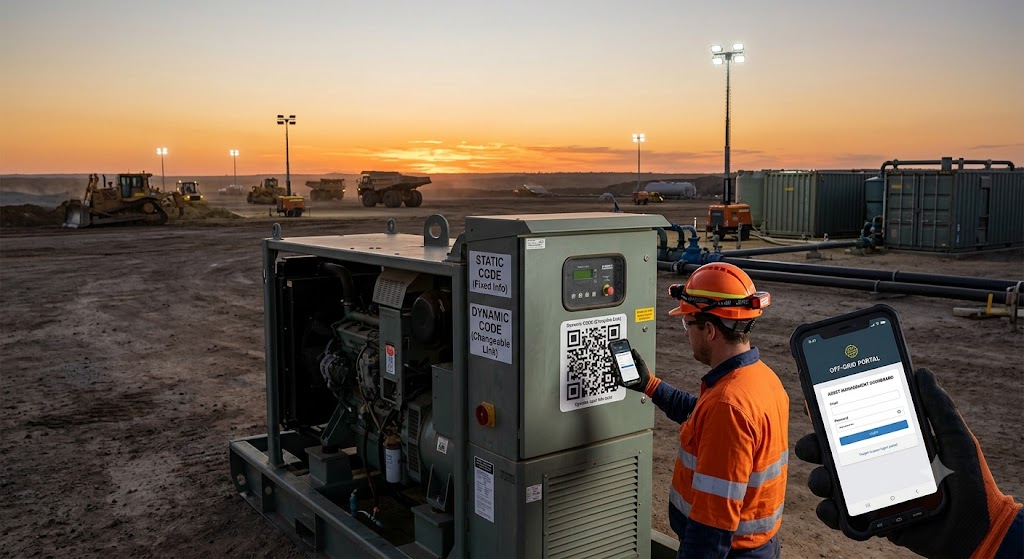
Discover how mining, construction and remote utility teams can use QR codes to access equipment documents, report faults, maintain compliance and reduce costly operational downtime.
In mining, civil construction, remote utilities and other heavy industries, a single equipment failure can disrupt an entire operation.
When crews are working hundreds of kilometres from the nearest depot, a missing manual, incorrect part number or delayed fault report is more than an inconvenience. It can mean idle machinery, interrupted production and expensive mobilisation costs.
Many organisations still depend on printed manuals, laminated inspection sheets, spreadsheets and phone calls to manage critical equipment information. These processes are difficult to maintain and even harder to rely on across remote or harsh operating environments.
A weather-resistant QR code attached to a machine, generator, pump, vehicle or infrastructure asset can provide field teams with a direct connection to the information and systems they need.
Here are four practical ways QR codes can help remote operations reduce downtime and improve asset management.
1. Provide Instant Access to Equipment Information
Paper manuals can become damaged, outdated or separated from the equipment they belong to.
A QR code placed on an equipment label or asset identification plate can give technicians immediate access to relevant digital resources, including:
- Operating and maintenance manuals
- Wiring diagrams and technical schematics
- Troubleshooting procedures
- Spare-parts catalogues
- Equipment serial numbers
- Inspection instructions
- Manufacturer contact information
Instead of returning to a vehicle, site office or central depot to search for documentation, technicians can scan the code beside the equipment and access the information on their phone or tablet.
For permanent information that is unlikely to change, a static QR code may be sufficient. However, a dynamic QR code provides greater flexibility because the destination can be updated without replacing the physical label.
2. Connect Physical Assets to Live Digital Systems
A dynamic QR code can act as a digital entry point for each physical asset.
The same code can direct authorised employees to an asset management system, maintenance platform or industrial IoT dashboard. Depending on the organisation’s systems and security controls, the destination may provide access to:
- Equipment running hours
- Fuel, water or battery levels
- Temperature and pressure readings
- Current equipment status
- Service history
- Upcoming maintenance requirements
- Inspection and compliance records
The QR code does not collect this information by itself. Instead, it provides a fast and convenient way to open the relevant dashboard or asset record.
Access can also be protected through authentication, employee accounts or role-based permissions so that sensitive operational data is not publicly available.
3. Simplify Fault Reporting and Maintenance Requests
Incomplete or inaccurate fault reports can delay diagnosis and dispatch decisions.
A QR code can link operators directly to a fault-reporting form associated with a particular asset. The form can be configured to include information such as:
- Asset identification number
- Equipment type and model
- Site or operational area
- Maintenance category
- Priority or severity
- Photo and video uploads
- Operator comments
Where supported by the user’s device and permission settings, the form may also capture the operator’s current location. Alternatively, the asset’s registered site or location can be populated from the maintenance system.
This reduces the need to manually enter serial numbers or describe which piece of equipment has failed. It also helps maintenance teams receive more complete and consistent information before travelling to the site.
The result can be faster triage, fewer communication errors and shorter equipment outages.
4. Keep Safety and Compliance Documents Current
Heavy-industry operations must manage a wide range of safety, training and compliance information.
This may include:
- Safety Data Sheets
- Safe Work Method Statements
- Job Hazard Analyses
- Pre-start inspection forms
- Equipment certifications
- Isolation procedures
- Emergency instructions
- Operator competency requirements
Printed documents can quickly become outdated when a procedure, certificate or safety requirement changes.
With a dynamic QR code, the physical label can remain in place while the destination document is updated online. Employees scanning the code can then be directed to the current approved version.
Document owners should still apply appropriate version control, access permissions and approval processes. The QR code improves access, but it should operate as part of the organisation’s broader safety and document-governance framework.
Designing QR Codes for Harsh Environments
Industrial QR codes need to remain usable in conditions that may include dust, water, grease, direct sunlight, vibration and extreme temperatures.
When deploying QR codes on heavy equipment, consider:
- Using durable, weather-resistant labels or engraved plates
- Maintaining strong contrast between the code and its background
- Leaving sufficient clear space around the code
- Avoiding reflective or highly curved mounting surfaces
- Choosing a size suitable for the expected scanning distance
- Testing with the devices used by field crews
- Including a readable asset number as a fallback
- Inspecting and replacing damaged labels during scheduled maintenance
Remote sites may also have limited mobile connectivity. Critical documents should therefore be designed with connectivity constraints in mind. Options may include downloadable files, locally available site networks, cached documents or offline-capable maintenance applications.
Static or Dynamic QR Codes: Which Should You Use?
Static QR codes point permanently to the information encoded when the code is created. They are useful for stable destinations that are not expected to change.
Dynamic QR codes allow the destination to be updated after the label has been printed. They are generally better suited to operational environments where documents, systems or workflows may evolve.
Dynamic codes can also support scan analytics, helping organisations understand how frequently equipment resources are being accessed. Analytics should be implemented in accordance with organisational privacy and security requirements.
For many industrial asset-management scenarios, dynamic QR codes offer the strongest long-term value because equipment labels do not need to be replaced every time a digital resource changes.
Keep Remote Operations Moving
Modern industrial efficiency depends on more than the mechanical performance of an asset. It also depends on how quickly employees can access reliable information, report problems and initiate the correct operational process.
QR codes provide a relatively simple and cost-effective way to connect physical equipment with digital manuals, maintenance workflows, safety documents and asset-management systems.
When implemented with durable labels, secure destinations and well-managed digital content, QR codes can help organisations:
- Reduce time spent searching for information
- Improve the quality of fault reports
- Accelerate maintenance response
- Keep safety documents current
- Strengthen asset visibility
- Reduce avoidable operational downtime
Create Smarter QR Codes for Your Equipment
QRco.au makes it easy to create and manage branded static and dynamic QR codes for equipment, vehicles, facilities and field operations.
Create QR codes that connect your teams to the information they need—and update destinations without repeatedly replacing labels.
Start creating your industrial QR codes with QRco.au.