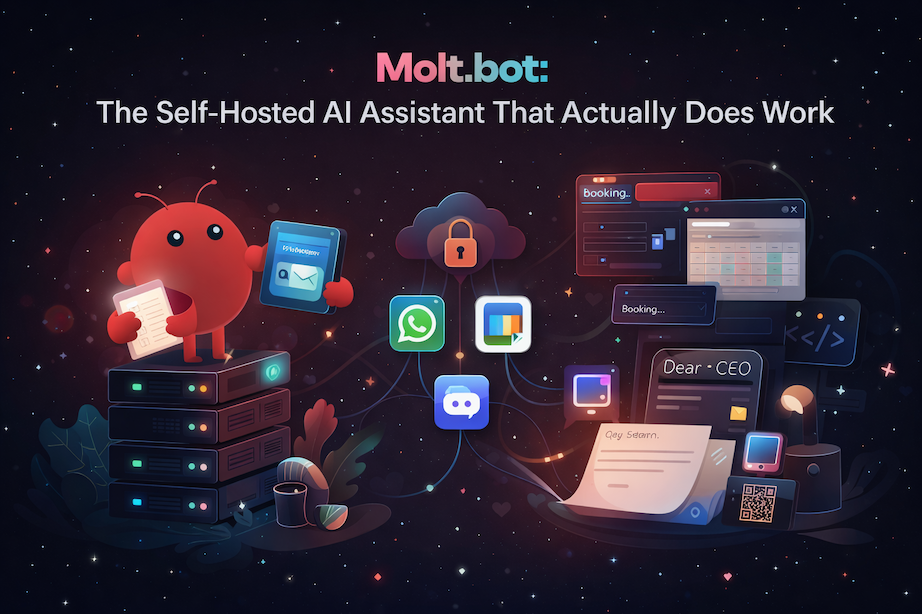
Molt.bot is a self-hosted, open-source AI assistant that runs on your own server and actually does work—email, calendar, automation, and more.
Update: MoltBot gets another new name, OpenClaw.ai
Most AI “assistants” today are still just that — assistants in name only. You ask a question, they answer. Maybe they draft a paragraph or summarize a doc. And then… you still have to do the work.
Molt.bot is different.
Formerly known as ClawdBot, Molt.bot is an open-source, self-hosted AI assistant that runs on your machine or server and can actually execute tasks, not just chat about them. It lives where you already work — WhatsApp, Telegram, Discord, iMessage — and behaves less like a chatbot and more like a 24/7 AI employee.
For founders and small teams, that shift matters.
What is Molt.bot (formerly ClawdBot)?
Molt.bot is an open-source AI agent platform created by Peter Steinberger (founder of PSPDFKit). It lets you run a personal AI assistant on your own infrastructure — a laptop, VPS, home server, or even a Raspberry Pi.
Instead of being locked into a SaaS chatbot, you host the entire stack yourself:
- Your data stays on your machine
- Your workflows are fully customizable
- Your assistant can connect directly to your tools
Originally launched as ClawdBot (with the AI persona “Clawd”), the project rebranded to Molt.bot and Molty in early 2026 after Anthropic requested a name change due to trademark concerns.
The rebrand was framed as a “molt” 🦞 — lobsters shed their shells to grow. Same core agent, same capabilities, just a new name.
Why Molt.bot matters: from chatbots to AI agents
Traditional chatbots are front-ends. You ask, they reply.
Molt.bot is built as an AI agent — meaning it can plan, execute, and follow through.
From a user’s perspective, this is the key shift:
You don’t talk to Molt.bot. You delegate work to it.
You can message your assistant things like:
- “Research Acme Corp and draft an intro email to their CEO”
- “Summarize today’s support emails and flag anything urgent”
- “Log into the admin panel and export last week’s reports”
And Molt.bot actually does it — chaining multiple steps behind the scenes.
How Molt.bot works (at a high level)
Molt.bot combines messaging, large language models, and real tooling into one system:
1. Self-hosted gateway
Runs on your server or PC and connects to messaging apps like:
- WhatsApp (via Baileys)
- Telegram
- Discord
- iMessage
- MS Teams, Mattermost (via plugins)
To you, it’s just a contact in chat.
2. AI agent bridge
Behind the scenes, Molt.bot talks to real LLMs (Claude, OpenAI, others) that can:
- Reason through multi-step tasks
- Write and execute code
- Use tools and APIs
You can even run multiple agents (e.g. one for reasoning, one for code) and delegate automatically.
3. Browser & system automation
This is where Molt.bot really pulls ahead of chatbots:
- Launches Chrome / Chromium
- Navigates websites
- Logs in, fills forms, uploads files
- Takes screenshots and scrapes data
No API required — it works wherever a human would.
4. Local data & memory
Your chats, files, credentials, and workflows live on your machine, not a third-party cloud. This is huge for privacy-sensitive workflows and internal tooling.
Core features (2026)
Messaging & voice
- WhatsApp, Telegram, Discord, iMessage, MS Teams
- Send/receive images, audio, documents
- Voice notes with transcription (Whisper, ElevenLabs, etc.)
AI agent capabilities
- Connects to Claude, OpenAI, and other models
- True multi-step reasoning (research → write → act)
- Multi-agent mode for complex workflows
Automation & tools
- Full browser automation (forms, bookings, scraping)
- Custom “skills” and reusable workflows
- Local file system, CLI tools, IDEs, Git, CI/CD
Developer & ops tooling
- Local dashboard + CLI
- Event hooks (e.g. “on new email → summarize to Telegram”)
- Plugins for CalDAV, Home Assistant, Jira, Linear, and more
What Molt.bot is great for
Because it can run code and control real tools, Molt.bot shines where chatbots fall short.
Personal productivity
- Email triage and draft replies
- Calendar scheduling and reminders
- Research and one-page summaries
Business & startup workflows
- Lead monitoring and sales follow-ups
- Internal support automation
- Accounting intake and document prep
Developers & tech teams
- PR and code reviews
- Running dev and ops commands from chat
- Natural-language access to Jira, Linear, GitHub
Home & hardware
- Smart home control via Home Assistant
- IoT devices (printers, vacuums, sensors)
- Simple chat-based device commands
Setup & cost: surprisingly accessible
Molt.bot is especially attractive for founders and small teams who want power without enterprise SaaS pricing.
Typical setup
- 1 small VPS (1–2 GB RAM)
- Molt.bot gateway + agent
- Claude (Sonnet or Opus) + optional OpenAI for code
- Integrations: Gmail, Calendar, GitHub, WhatsApp/Telegram
Rough monthly cost (solo founder)
- Hosting: $5–10
- AI models: $15–50 (usage-dependent)
- Messaging: minimal to a few dollars
So a basic 24/7 “AI employee” can start around $20–50/month — far cheaper than a human VA, and far more programmable.
Molt.bot vs traditional chatbots
FeatureTraditional ChatbotMolt.botIntelligenceFixed scriptsTrue LLM reasoningActionsMostly repliesRuns code & automates toolsCustomizationManual rule updatesSkills evolve dynamicallyDataVendor cloudSelf-hostedUse casesFAQs, routingEnd-to-end workflows
This is the key shift: from chat support to real work execution.
Why this matters for qrco.au
At QRCO, we think a lot about moving work to the edge — closer to users, closer to context, and closer to real-world action.
Molt.bot is a great example of the same philosophy in AI:
- Own your stack
- Control your data
- Automate real tasks, not just conversations
Just like a custom QR-driven task flow gives businesses control over how work is triggered and completed, self-hosted AI agents like Molt.bot give founders control over how automation actually runs.
The bigger trend is clear: AI isn’t just answering questions anymore — it’s becoming part of the workforce.
Final takeaway
Molt.bot isn’t a chatbot. It’s an AI agent — one you can host, customize, and trust with real work.
For founders, product teams, and operators looking to automate without giving up control, it’s one of the most compelling examples of where AI is heading next.
And it’s a strong reminder that the future of automation isn’t just smarter chat — it’s AI that actually gets things done.